

You walk into a barber shop. The barber asks, “Taper or fade?” You freeze. Both cuts look clean. Both keep the sides short. So what is the real difference? Many guys pick one and hope for the best. That can lead to a haircut you did not want. The good news is that the answer is simple.
This guide covers Low Taper vs Low Fade: Key Differences & Which to Choose in plain words. You will learn how each cut looks. You will see how they grow out. You will also learn which one suits your hair, face, and style. Do not worry if the terms sound confusing right now. Some cuts need more upkeep than others. Some work better for work or school. By the end, you will know exactly what to ask your barber. Let us get started.
⚡ Quick Answer: Low Taper vs Low Fade
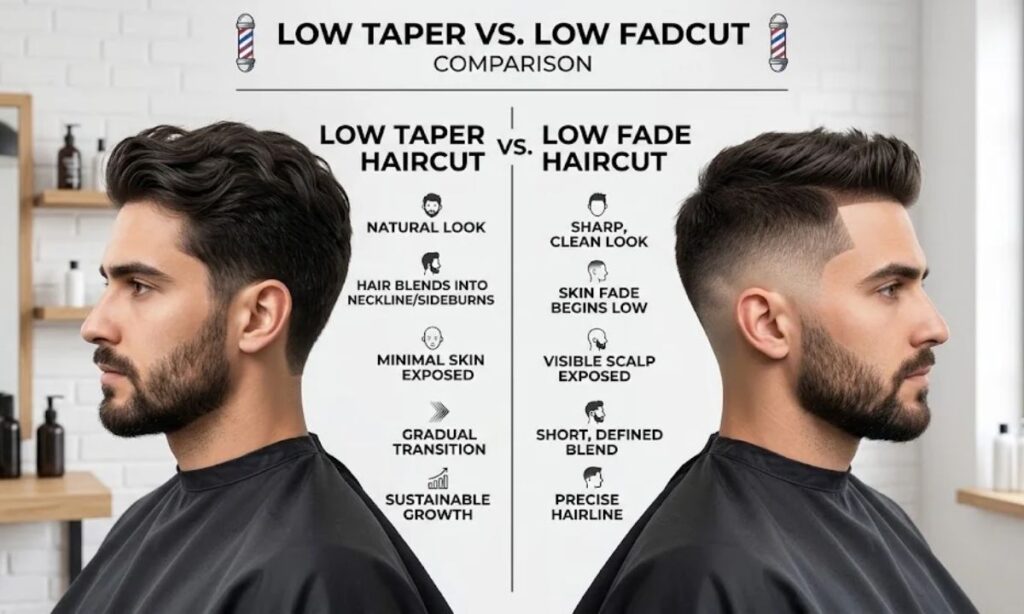
A low taper trims the hair gradually, mostly at the sideburns and neckline. It leaves length around the ears. A low fade blends the sides down to very short hair or bare skin, starting low near the ear.
In short: taper means subtle, fade means contrast. Pick a taper for a classic, professional look. Pick a fade for a sharper, bolder finish.
What Is a Low Taper?
A low taper is a gentle cut that shortens the hair step by step. It happens low on the head, around the sideburns, behind the ear and at the nape.
The key point is that the hair doesn’t usually go to skin. Most barbers stop at a guard or leave a small amount of length. The sides keep some bulk, so the result looks neat but natural.
Here’s what defines it:
- The change in length is small and gradual.
- It focuses on the edges: sideburns, ears and neckline.
- Hair around the ear stays visible, not buzzed away.
- It looks clean even when it grows out a bit.
Think of it as a polished version of a regular haircut. People often notice you look sharp, but they can’t say exactly why.
What Is a Low Fade?
A low fade blends the hair from longer on the upper sides to very short, or even skin, at the bottom. It starts low, just above the ear, and curves toward the back of the head.
The blend is more noticeable than a taper. You can see the hair “fading” into the skin. Barbers can finish it with a guard, a shaver or a foil shaver for a skin look.
Here’s what defines it:
- The contrast between top and sides is stronger.
- The shortest point can reach bare skin.
- The blend covers more area around the ear and nape.
- It looks crisp, especially right after a cut.
Because it starts low, it’s the gentlest type of fade. It gives you the fade look without taking much hair off the sides.
🔍 Low Taper vs Taper Fade: What Is the Actual Difference?
People often mix up “low taper” and “taper fade.” They sound alike, and barbers don’t always use the same words.
A low taper keeps things subtle and short at the edges only. A taper fade is a hybrid. It uses the same gradual idea as a taper, but the blend goes shorter, sometimes to skin. That makes it a middle option.
The difference comes down to three things:
- How short it goes at the bottom. A taper stops higher. A taper fade goes closer.
- How much area is blended. A taper covers edges. A taper fade covers more of the sides and back.
- How visible the blend is. A taper is almost unnoticeable. A taper fade is easier to see.
If you want a safe option that isn’t plain and isn’t dramatic, a low taper fade is often the answer.
📊 Low Taper vs Low Fade at a Glance
Here’s a quick side-by-side. Save it for your next visit.
| Feature | Low Taper | Low Fade |
| Where it starts | Sideburns and neckline | Just above the ear, low on the head |
| Shortest point | A guard length, not usually skin | Short stubble or bare skin |
| Contrast | Soft and subtle | Sharper and clearer |
| Overall vibe | Classic, professional | Modern, crisp |
| Grow-out | Slow and graceful | Faster to look uneven |
| Typical touch-up | Every 3–5 weeks | Every 2–3 weeks |
| Best for | Office, school, everyday | Style-focused, events, social |
Low Taper vs Low Fade vs Low Taper Fade
Now add the third option. This table shows how the three compare.
| Cut | Shortness | Visibility | Best for |
| Low taper | Least short | Subtle | Conservative settings |
| Low taper fade | Short, may reach skin | Medium | Balance of both |
| Low fade | Shortest, often skin | Strong | Bold, clean look |
If you can’t choose, the low taper fade sits in the middle. It’s the “safe but sharp” choice. Many barbers recommend it for first-timers.
🎯 Which Looks More Natural?
The low taper looks more natural. It follows the head’s shape and the hairline, and it doesn’t create a clear “line” of contrast. Even when it needs a trim, it still looks tidy.
The low fade looks more styled. That’s not a bad thing. It stands out because it’s designed to. You see the blend, and the skin shows. It looks intentional.
A simple way to think about it:
- Natural, understated: low taper.
- Defined, styled: low fade.
- In between: low taper fade.
Where Each Cut Works Best
Setting matters as much as taste. Here’s how each cut fits real life.
Low taper works best for:
- Offices and strict dress codes
- Job interviews
- Weddings and formal events
- Schools and sports teams with grooming rules
- Anyone who wants a neat look with little fuss
Low fade works best for:
- Creative or relaxed workplaces
- Nights out and social events
- Gym and active lifestyles (clean, cool and easy to keep neat)
- People who want a sharper outline
- Beard wearers who want a smooth blend into the beard
If your workplace is conservative, start with a taper. You can always go shorter next time. You can’t put hair back.
🧑🦱 Choosing Based on Your Face Shape
Face shape isn’t a strict rule, but it helps. The goal is to balance your features.
| Face shape | Better choice | Why |
| Oval | Either | Most cuts work with balanced proportions |
| Round | Low fade | Adds a sharper outline and slims the sides |
| Square | Either | A taper softens, a fade sharpens the jaw |
| Oblong | Low taper | Keeps width on the sides and avoids extra height |
| Heart | Low taper | Adds balance near the jaw and keeps sides natural |
A few extra tips:
- Round faces look better with some height on top. Pair a low fade with a textured crop or quiff.
- Narrow faces benefit from not taking too much off the sides.
- If you have a strong jaw, a low fade will show it off.
Don’t overthink it. Head shape, hairline and density matter too. A good barber will tell you what works.
💇 Choosing Based on Your Hair Type

Hair texture changes how each cut looks. The same cut can look soft on one head and sharp on another.
Low Taper vs Low Fade on Black Hair
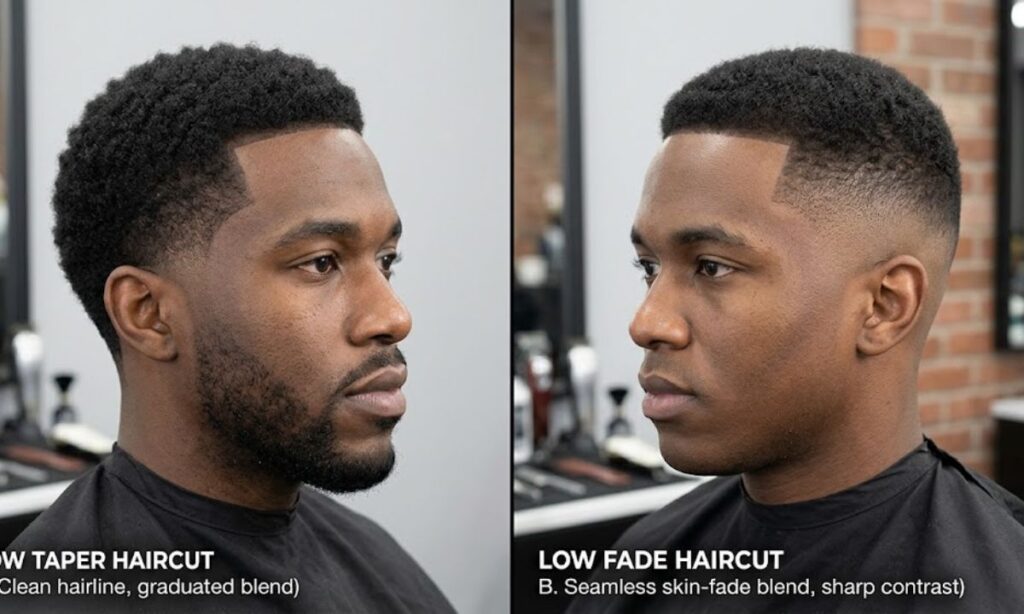
Both cuts work very well on Black hair, and both are popular. The difference is in the finish.
Low taper:
- Gives a classic, clean shape. It works with an afro, twists, short coils and a natural top. The lineup and neckline stay neat without losing volume.
Low fade:
Adds strong definition. It pairs well with waves, a 360 wave pattern, a high-top or twists. The contrast makes the top pop.
Two things to watch:
Razor bumps:
Skin fades can irritate sensitive skin. Ask for a guard finish if you get bumps often.
Edge-up:
A clean lineup makes both cuts look sharper. Ask for it, but keep the hairline natural.
If you want less upkeep, go with a low taper. If you want a polished, high-contrast look, go with a low fade.
Straight, Wavy and Curly Hair

Straight hair:
It shows every detail. A low fade looks very clean, but mistakes show too. A low taper hides small blends better. Fine hair may show scalp through a skin fade.
Wavy hair:
Both cuts work well. The waves add movement on top while the sides stay tidy. A low taper keeps the shape soft. A low fade adds extra contrast.
Curly hair:
Curls look great with either cut. A low fade makes the curls stand out. A low taper keeps the whole look softer. Leave enough length on top so the curls can form.
🗓️ Maintenance and How Long Each Lasts
Hair grows about half an inch a month. That matters most on the sides, where the blend is short.
| Cut | When it looks best | When it needs a trim |
| Low taper | First 2–3 weeks | Around weeks 3–5 |
| Low fade (guard) | First 2 weeks | Around weeks 2–4 |
| Low fade (skin) | First 1–2 weeks | Around weeks 2–3 |
Why the difference? A fade shows regrowth faster. Once the skin area grows in, the blend looks fuzzy. A taper hides regrowth better because the change is gradual.
Simple ways to make either cut last:
- Book your next visit before you leave.
- Use a small trimmer for the neckline between visits (carefully).
- Keep the skin around the ears moisturized.
- Don’t wash with harsh shampoo every day.
If you hate frequent visits, choose the low taper. If you don’t mind a quick trim every few weeks, the fade is fine.
✂️ Best Styles to Pair With Each Cut
The sides are only half the haircut. The top decides the final look.
Popular styles for a low taper:
- Classic side part: Clean and professional.
- Textured crop: Easy and modern.
- Quiff or pompadour: Adds height and style.
- Longer, natural hair: Keeps a neat edge.
- Afro or twists: Gives shape and definition.
Popular styles for a low fade:
- French crop: Short fringe, sharp sides.
- Slick back: Smooth and sleek.
- Curly top: Extra contrast.
- Spiky or messy top: Casual and youthful.
- Waves or high-top: Bold and clean.
Quick pairing guide:
| Top style | Low taper | Low fade |
| Side part | ✅ Excellent | ✅ Good |
| Textured crop | ✅ Good | ✅ Excellent |
| Quiff | ✅ Good | ✅ Excellent |
| Curly top | ✅ Good | ✅ Excellent |
| Longer hair | ✅ Excellent | ⚠️ Depends |
💬 How to Ask Your Barber
Most haircut problems come from vague requests. A clear brief fixes it.
Tell your barber these four things:
- The cut: “Low taper,” “low fade” or “low taper fade.”
- The closeness: “Skin at the bottom” or “a number 1 or 2 guard.”
- The top length: Show it with your fingers or say it in inches.
- The finish: Natural neckline, squared or rounded, with or without a lineup.
Example script:
“I’d like a low taper fade. Go to a number 1 at the bottom, leave about three inches on top and keep the neckline natural.”
More tips:
- Bring two or three photos, front and side views.
- Choose photos with hair like yours.
- Say if you want it softer than the photo.
- Speak up if you don’t like it. Barbers prefer feedback.
🏁 So, Which Should You Choose?
Here’s a simple way to decide.
Choose a low taper if you:
- Want a classic, professional look
- Prefer low upkeep
- Like a natural finish
- Have a strict dress code
Choose a low fade if you:
- Want sharper contrast
- Like a modern, styled look
- Don’t mind regular trims
- Wear a beard or textured top
Choose a low taper fade if you:
- Can’t decide
- Want something in the middle
- Want a safe first fade
Still stuck? Start with the taper. It’s easier to go bolder next time.
🔄 Other Taper and Fade Types to Know
Height changes the whole look. Here’s how the other options compare.
Mid Taper Fade and Mid Fade
A mid taper fade starts around the middle of the sides, near the temple. A mid fade does the same but goes shorter, often to skin.
Both give more contrast than a low cut. They’re a good middle ground if you want a stronger look but not too extreme. Expect trims every two to three weeks.
High Taper Fade
A high taper fade starts higher, close to the temples or crown. It removes more hair from the sides, so it looks bold and sharp.
It needs the most upkeep because regrowth shows fast. It works well with a long top, like a pompadour or curly hair.
Burst Fade
A burst fade curves around the ear in a half circle and leaves the back long. It’s different from a straight low fade because of its shape.
It pairs well with mullets, mohawks and curls. If you want a cut with shape and personality, ask for a low or mid burst.
❓ Frequently Asked Questions
What is the difference between a taper and a fade?
A taper trims hair gradually and keeps some length at the sides. A fade blends down to very short hair or bare skin.
Is a low taper or a low fade better?
Neither is better. A low taper looks softer and classic. A low fade looks sharper and more defined.
How often should I touch up a low taper or low fade?
Every two to four weeks. A skin fade needs trims sooner than a taper.
Which cut works better on curly or coily hair?
Both work. A low fade adds contrast, and a low taper keeps the look softer and tidier.
Can I get a low taper or low fade with a beard?
Yes. Ask your barber to blend the fade into the beard for a smooth transition.
Is a low taper more professional than a low fade?
Often, yes. It looks subtle and conservative, which suits strict dress codes.
Which cut is easier to grow out?
A low taper. The change is gradual, so it keeps looking tidy for longer.
How much does a low taper or low fade cost?
Prices vary by barber and location. Most charge about the same for both.
🏆 Final Thought
Both cuts look sharp. Both keep the sides neat. The main difference is the finish. A low taper fades the hair slowly. It keeps some length near the skin. A low fade goes shorter. It can blend down to the skin. That gives a bolder look. Now you know what sets them apart.
In short, Low Taper vs Low Fade: Key Differences & Which to Choose comes down to your style. Both work. Pick a low taper for a soft, neat look. It suits work and school. It also grows out well. Pick a low fade for a sharper, modern look. It needs more trims. Think about your hair type and your daily routine. Then talk to your barber. Be clear about the length you want. A good cut starts with a good chat. Choose the one that feels right.

Owen Blake is a fashion writer and style enthusiast contributing to Faxhion Megazine. With a focus on fashion trends, personal style, seasonal looks, and practical styling ideas, Owen creates clear, reader friendly content. His work combines trend awareness, careful research, and an interest in helping readers make confident, informed fashion choices.